Shitennoji Temple
OsakaAirport.com » Japan Tourism » Osaka Tourism » Shitennoji TempleThe earliest Buddhist temple in Japan is also one of the temples believed by the Japanese. Built in 593, the deity enshrines the Avalokitesvara Bodhisattva, which is said to be built by Prince Shotoku.
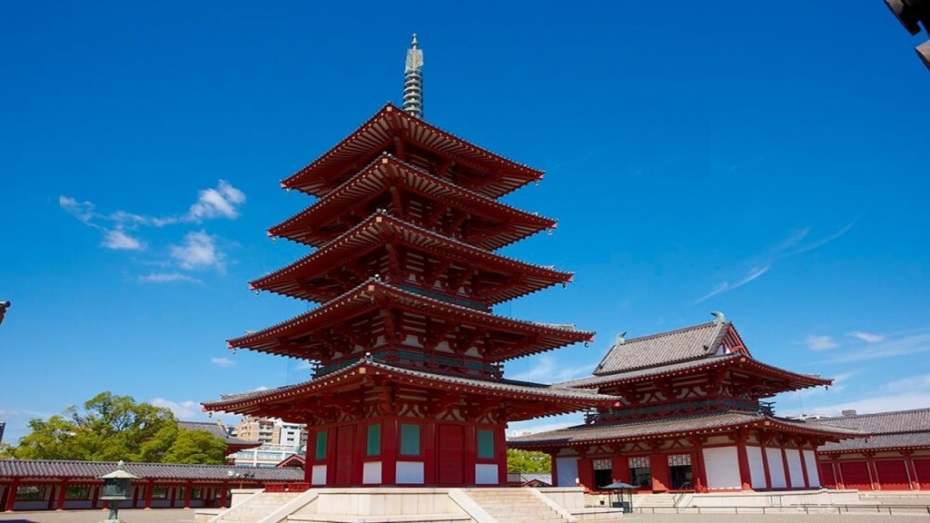
The red pillars and white walls of
the buildings are unified in style, with religious characteristics of the
Southern and Northern Dynasties of China, and the elegance of the Asuka era.
Shitennoji has two entrances, one is the south gate on the south side, and the
other is the Gekulemun gate on the west side. Generally, you can get off at
Shitennoji Yunooka Station on the subway station, and you can walk all the way
south in the alleys. When you see the stone torii gate, you will arrive at
Shitennoji. This is an ancient stone torii gate that exists throughout Japan. It
was originally made of wood, but was replaced with stone in 1294. It is rich in
history, precious and unique.
Passing through the torii gate, you will arrive at the Gate of Bliss, which
means the gate to the west, so it is located on the west side of the temple.
Passing through the Gate of Bliss, you can see the portraits of Bodhisattvas
such as the ten disciples of Shakyamuni Tathagata, and four prayer wheels. When
passing by, you can turn the law wheel, which represents the believer's direct
contact with the Dhamma and accumulate merit.
Shitennoji-style garan can enter the center garan through the west gate. This is
the center of the temple. From south to north, you can see the central gate,
five-storied pagoda, golden hall, and lecture hall in the courtyard. , Is called
"Shitennoji style Garan". This architectural style originated from China and
North Korea. During the Southern and Northern Dynasties of China, a large number
of temples were built with pagodas as the center.
The five-storied pagoda is an important building in the center of Garan. The top
of this five-story wooden pagoda is a stupa, which houses six relics. There are
entrances to the north and south of the tower, but usually only the north
entrance is open, and the murals of Sakyamuni and the wooden statues of the Four
Heavenly Kings are enshrined on the south. The Golden Hall and the five-storied
pagoda are located together in the center, which is dedicated to Guanyin and is
guarded by the four heavenly kings.
There will be a small relic display ceremony starting at 11:00 every day. If you
are a devout Buddhist, don't miss this sacred moment. The lecture hall is a
place to promote the classics. Opposite the central axis is the central gate.
There are two vajra warriors. They are fierce and have the meaning of guarding
the temple. Going out from the middle door is the south gate of the entire
temple. Go eastward around the outer wall of the cloister in the center of Garan,
and you will see a small courtyard, which is the Holy Spirit Courtyard, which
was built to commemorate Prince Shotoku.
The treasure hall is next to the holy spirit courtyard. You must take off your
shoes when you enter the museum. You can't take pictures in the museum. As soon
as you enter the door, you will see two very magnificent wooden temples and
monuments. After going upstairs, you will see the treasures of Prince Shotoku's
life and deeds, paintings, scriptures and other treasures. In addition to the
exhibits related to the Prince and the general display of the Pure Land School,
there are often various temporary limited special exhibitions. For detailed
exhibition news, please pay attention to official information.
Going north out of the treasure hall, you will find a pond called the turtle
pond behind the lecture hall. In the middle of the pond is a stone stage. It was
pointed out by the gods of sacrificial dances in ancient times that it is very
sacred. Now every April 22nd, there is a holy spirit dance music festival to
commemorate Prince Shotoku. At that time, you can see dance music that is said
to have been passed down from ancient times and is performed on the stone stage.
Usually, a large group of tortoises swim in the tortoise pond. When the weather
is fine, groups of tortoises will climb on the rocks in the pond to bask in the
sun, which is a big sight in the temple.
Behind the turtle pond is the Six Hours Hall, where various rituals and dharma
meetings are held. The Japanese-style courtyard in the north of the temple is a
Japanese-style courtyard-the Pure Land of Bliss, which is built on the prototype
of the Pure Land of Bliss in the Buddhist classics. There are two gurgling
streams meeting in the courtyard, implying the three poisons in the world, but
they can't stay in this courtyard and can only be constantly washed.
Strolling through the courtyard, you will see a pavilion with a Western style.
This is the octagonal pavilion built in the Meiji period. To enjoy a sunset, the
rows of red eaves pillars in the Sitianwang Temple are solemn and solemn. You
might as well take a walk here, or sit still for a while, stealing half-day
peace in the hustle and bustle and feel the supreme coolness. The west gate is a
good place to enjoy the sunset, and is known as the "Sunset Hill". In addition,
the west of the temple faces the sea, and the west is recognized by Buddhism as
the pure land of bliss. Many monks or devout Buddhists will choose to worship
here.
undo...back